
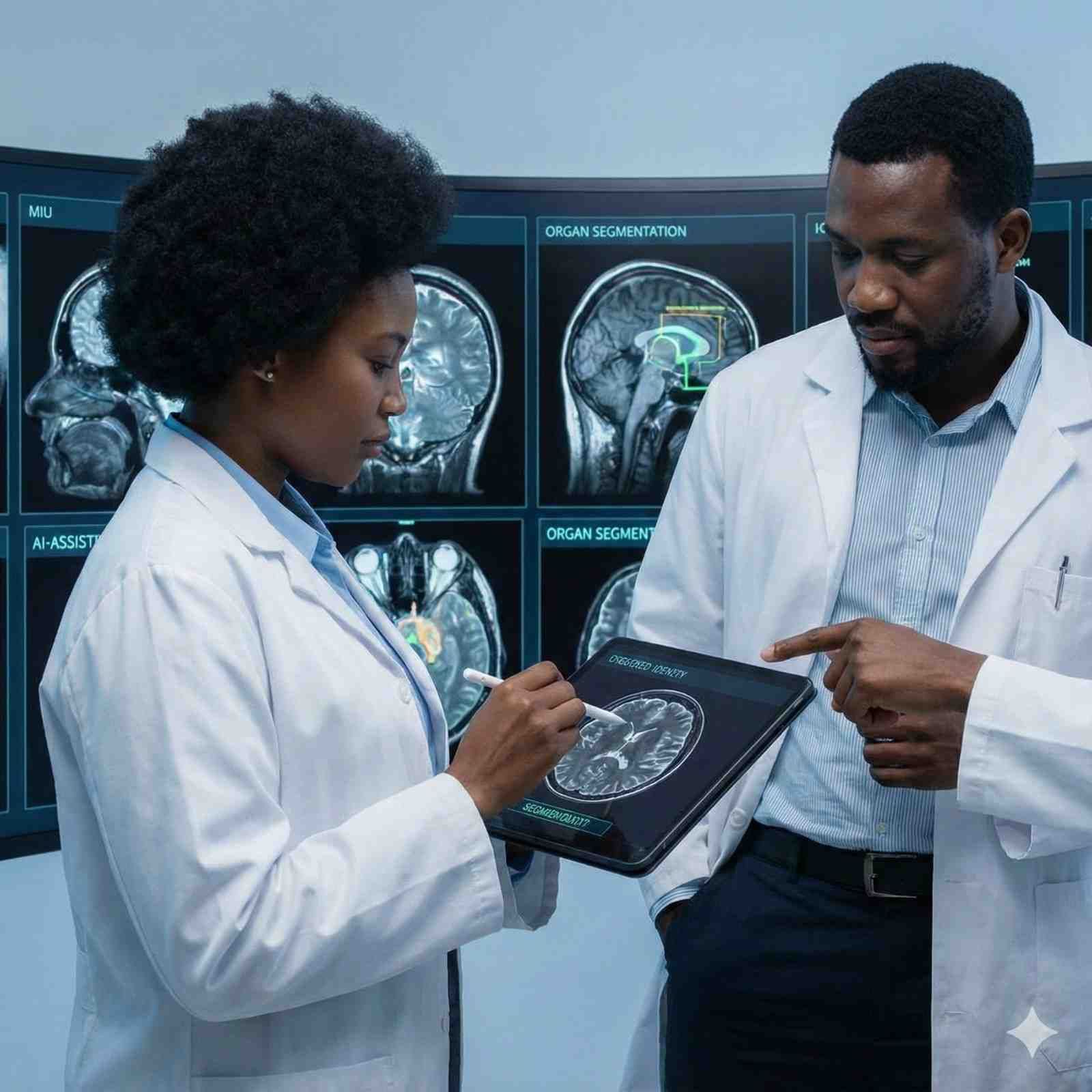
How AI Is Transforming Medical Imaging
The AI revolution is reshaping healthcare, and medical imaging stands at the forefront. Discover how labeled datasets and human-AI collaboration are powering life-saving diagnostics and why overcoming the global data-annotation gap is the key to inclusive, next-generation care.
December 29, 2025
In 2022, the world witnessed what can only be described as a technological tidal wave. Generative AI burst onto the global stage, disrupting industries, reshaping economies, and redefining what innovation looks like in real-time. What began as a breakthrough quickly became a race, one where technopreneurs, enterprises, and governments alike scrambled to harness AI’s transformative potential.
As a Computer Engineer and AI enthusiast, what stood out was how AI adoption accelerated at an unprecedented pace across healthcare, finance, retail, manufacturing, transportation, agriculture, education, and telecommunications. As a result of this accelerated shift, the payoff has been substantial with reduced operational costs, improved accuracy, faster service delivery, predictive and data-driven decision-making, and highly personalized services. Beyond efficiency, AI has sparked a broader economic ripple effect that is reshaping job markets and enabling entrepreneurs from anywhere in the world to build solutions capable of impacting millions, if not billions of lives.
While there is no shortage of insights on AI’s growing influence, this article focuses on one particularly powerful and life-saving application which is the integration of AI in medical imaging within the healthcare industry.
AI Meets Medical Imaging
Medical imaging sits at the heart of modern healthcare. Technologies such as X-ray, CT scans, MRI, and ultrasound allow healthcare experts to look beneath the surface and support the diagnosis, monitoring, and treatment of health conditions ranging from bone fractures and tumors to cardiovascular diseases and pregnancy complications.
Traditionally, interpreting these images has relied heavily on the expertise and availability of medical professionals. Today, AI is changing that equation. By integrating AI into medical imaging workflows, healthcare providers can dramatically accelerate image analysis while maintaining or improving diagnostic accuracy. This is made possible through advanced Machine Learning (ML) techniques, particularly Deep Neural Networks (DNNs) designed for image processing such as Convolutional Neural Networks (CNNs), U-Net, ResNet. These models have proven especially effective in detecting patterns, anomalies, and internal human structures within medical images. However, the power of these models hinges on one critical factor, data quality.
Why Data Is the Backbone of AI in Healthcare
AI models are only as good as the data they are trained on. For medical imaging systems to perform reliably in real-world clinical environments, they must be trained on clean, high-quality, and representative datasets. If the training data does not reflect the conditions under which the model will operate, accuracy can quickly deteriorate.
Establishing a reliable “ground truth” is therefore essential. In practice, this means training DNNs on labeled datasets rather than unlabeled ones. While unlabeled data requires models to learn patterns through unsupervised learning, this approach often limits precision, especially in complex medical images where accurate identification of specific organs or abnormalities is critical. On the other hand, labeled datasets provide explicit guidance to DNN models. Medical images are annotated so that models learn exactly what to look for, be it organs, tissues, tumors, or other anatomical features. The result of using labeled datasets is significantly improved accuracy in diagnosis, monitoring, and treatment guidance.
The Human-AI Partnership Behind the Scenes
Behind every successful AI-powered medical imaging system lies a crucial human contribution. Labeled medical images do not create themselves; they require the expertise of trained human anatomy specialists who carefully annotate internal structures such as organs, tissues, muscles, and fat deposits. This reality underscores an important truth that AI is not replacing humans; it is amplifying human expertise.
Rather than operating in opposition, AI, and humans function best in synergy. Yet this partnership also exposes a global challenge. There is a significant shortage of highly trained medical image data annotators capable of labeling the millions of images required to train robust AI models. The gap is even more pronounced in disadvantaged and underserved communities, where vast amounts of medical imaging data remain undocumented, uncollected, or unlabeled. With the right investments in data collection, cleaning, and annotation, these communities represent an untapped opportunity not only to advance AI but to dramatically improve access to quality healthcare. At Peakpoint Services, this challenge reflects a broader commitment to using AI responsibly, ensuring that technological progress translates into practical and inclusive healthcare solutions.
What the AI Race Looks Like Going Forward
By addressing data gaps and workforce shortages, AI-driven medical imaging has the potential to deliver earlier diagnoses, more accurate treatment plans, and better health outcomes for billions of people worldwide. So, the elephant in the room is this. If you want to be at the forefront of AI integration in medical imaging, what steps are you willing to take to enter the race because at Peakpoint Services, we are already in the midst of it.
You do not have to be first; you do not have to be last. You simply have to take that first step through the door. This is because the AI revolution in medical imaging is already underway, and those who have the drive to participate today will help define the future of healthcare tomorrow.
Want to Learn More?
Explore more insights and discover how PeakPoint can help transform your business operations.