
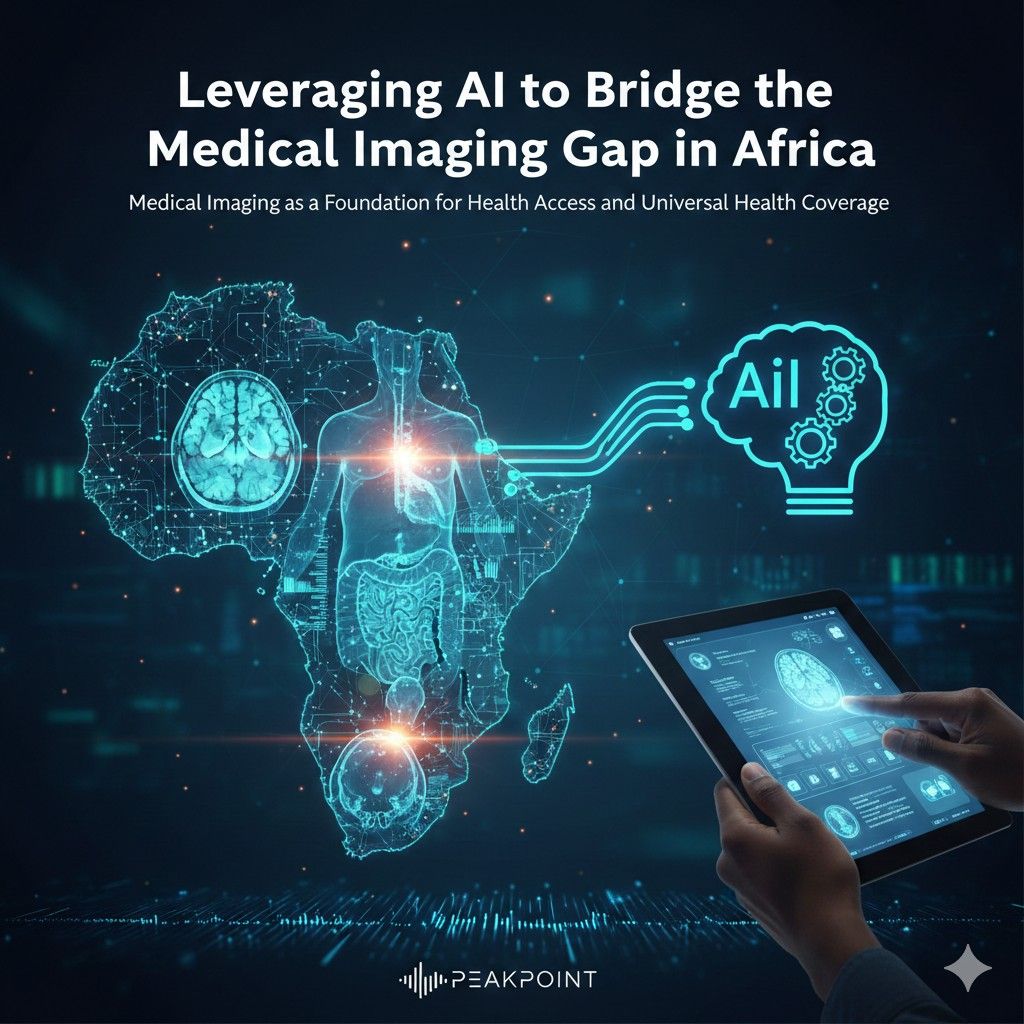
Leveraging AI to Bridge the Medical Imaging Gap in Africa
Medical imaging gaps in Africa represent a major barrier to universal health coverage. Discover how PeakPoint is leveraging AI to address workforce shortages and improve access to diagnostic care across the continent.
Medical Imaging as a Foundation for Health Access and Universal Health Coverage
Medical imaging, particularly advanced modalities such as magnetic resonance imaging (MRI) has made some of the most significant contributions to modern medicine, enabling improved disease diagnosis and better health outcomes for those who benefit from this technology. Despite the continued advances and proven value of MRI, limited access to and underutilization of medical imaging in low and middle-income countries (LMICs) mean that large segments of the population are being left behind.
This reality is especially alarming given the growing burden of non-communicable diseases (NCDs) in populations that are already grappling with the persistent demands of communicable diseases. The resulting gap in access to medical imaging in LMICs therefore represents a major barrier to achieving universal health coverage (UHC) [1]. Universal access to quality healthcare cannot be realized without addressing the medical imaging gap, access to radiological imaging is, fundamentally, access to care!
The impact of medical imaging, particularly MRI, on population health outcomes for those with access to this technology cannot be overstated. By offering superior soft tissue contrast and multiplanar imaging capabilities, MRI enables more accurate diagnosis and supports clinicians in delivering more informed and effective care pathways [2]. As such, MRI is essential to the diagnosis and management of both communicable and non-communicable diseases.
Rising Noncommunicable Diseases and Africa’s Imaging Capacity Crisis
In LMICs, particularly across Africa, access to MRI is becoming increasingly critical as these countries face a substantial increase in non-communicable diseases (NCDs), despite alarmingly low availability of this technology. Globally, the cancer burden is projected to reach 22.2 million new cases and 13.2 million cancer-related deaths by 2030, with the effects most pronounced in LMICs due to persistent gaps in access to healthcare [3]. Evidence indicates that up to 2% of these deaths can be averted through scaling up the access to medical imaging [3]. While high-income countries continue to benefit from advances and widespread availability of medical imaging, which plays a central role in cancer detection, diagnosis, and treatment, the persistent gaps in access to these technologies in Africa are likely to result in devastating cancer-related health outcomes.
This grim picture extends beyond cancer to several other non-communicable diseases (NCDs) such as stroke and neurological and heart disease, where limited access to medical imaging further exacerbates disease impact. The importance of medical imaging goes beyond availability alone, it plays a critical role in supporting clinicians to improve care pathways and in generating data that contributes to clinical research, disease-burden modeling, and more informed, targeted responses, including disease burden-based resource allocation.
Limited access to MRI for the majority of the African population has resulted in critical gaps in medical imaging data that could otherwise drive improvements in population health outcomes. These gaps are particularly evident in conditions that disproportionately affect people of African descent. For example, women of African descent have a significantly higher incidence of [uterine fibroids](https://integratingpulse.com/articles/mri-scans-fibroids-overview/), yet the condition remains severely under-researched. Although MRI is recognized as the gold standard for assessing uterine fibroids enhancing diagnostic accuracy and informing treatment decisions many women in LMICs remain excluded from this technology due to limited access. This exclusion further contributes to the absence of African populations in MRI imaging datasets, limiting the continuous improvement of evidence-based treatment protocols.
Structural Barriers to MRI Access in Africa
There is no question that accessibility to medical imaging or lack there-of is a significant barrier to access to care. One that needs immediate attention if most LMICs are expected to make significant progress in their efforts towards UHC by 2030. Effectively addressing this gap, however, requires understanding the main barriers to MRI medical imaging in low- resourced settings across Africa. These barriers will provide insights into feasible solutions to address the medical imaging gap, particularly in Sub-Sharan Africa that is lagging the furthest behind in the distribution of MRI with reported density of 0.7 to 1 MRI scanner per [1,4] million people compared to as high as 50 MRI machines per 1 million in high income countries like Japan.
First, the high cost of MRI technology remains the greatest barrier to expanding access. Governments must account not only for the substantial upfront costs of purchasing MRI equipment, but also for the infrastructure required to operate such advanced technology. A reliable electricity supply and climate-controlled facilities are prerequisites for MRI, yet these basic services are often not guaranteed in rural areas and even in some urban centers. In addition, the ongoing maintenance costs, which require highly skilled technicians, further constrain investment and often push MRI lower on national health priority lists.
Second, a severe shortage of a well-trained health workforce, particularly radiographers and radiologists capable of acquiring and interpreting MRI data remains a major barrier to access. This disparity is stark: low-income countries average just 1.9 radiologists per million people, compared to 97.9 per million in high-income countries [1]. The gap is driven largely by the limited number of radiography and radiology training programs across Africa, many of which lack the resources, advanced equipment, and clinical exposure required to build competency in sophisticated imaging modalities such as MRI. Many African countries also experience high attrition of skilled health workers, further straining already overburdened healthcare systems [5]. As a result, the few trained specialists available are overwhelmed by excessive workloads, leading to prolonged delays in image interpretation, growing diagnostic backlogs, and an increased risk of error, ultimately compromising the quality, safety, and timeliness of patient care.
Innovation as the Pathway to Equitable Imaging Access
The reality is the medical imaging gap in Sub Sharan Africa is too vast and barriers to expansion too complex for countries to make any measurable improvement towards medical imaging access goals by following the current trends. Given the gap and the trajectories for distribution of MRI in expanding access to medical imaging it would take decades before the distribution of MRIs achieved the proposed global standard for equitable access to these lifesaving interventions. Decades that many in Africa, mostly rural and already underserved populations do not have. Further delays in access would mean thousands of productivity years and lives lost due to unaddressed disease burden in this largely youthful population. The pertinent question is therefore what feasible solutions can be adopted to bridge this medical imaging gap given the current context?
Innovation is the answer. Globally, there has been a clear shift toward leveraging innovation and technology to address some of the most complex and persistent challenges in health. Significant investments have been directed toward innovation in long-standing challenges such as malaria eradication, with philanthropies like the [Gates Foundation](https://www.gatesnotes.com/Great-news-for-mosquito-haters) prioritizing novel tools that complement existing interventions rather than relying solely on incremental improvements to established strategies. Given the highly technological nature of medical imaging and the demonstrated gap affecting millions leveraging innovation is not just logical; it is imperative.
PeakPoint: Leveraging AI to Address Africa’s Medical Imaging Gap
That is exactly the path [PeakPoint](https://peakpoint.africa/) has embarked on. As a pioneering African technology company focused on solving complex systems challenges including critical gaps within health systems that require solutions capable of delivering rapid gains and measurable impact, PeakPoint is advancing efforts to close the medical imaging gap through the application of artificial intelligence.
PeakPoint’s approach targets the most salient barriers to accessing medical imaging in Africa through the use of rapidly advancing AI technologies. While affordability constraints and the resulting scarcity of medical equipment remain significant challenges, the severe shortage of a trained health workforce capable of operating MRI systems and interpreting digital imaging data may be the greatest barrier to access.
To address this gap, PeakPoint has joined the global effort to leverage machine learning by training AI algorithms that support automation in medical image analysis, enhancing clinical decision-making in disease diagnosis. This advancement has the potential to significantly improve workflow efficiency and diagnostic accuracy within an already overburdened health workforce.
Closing the Medical Imaging Gap as a Prerequisite for UHC
As an African-based technology company committed to using African imaging data to train its medical imaging AI algorithms, PeakPoint is also addressing a critical limitation of many existing AI models: underlying social and population bias resulting from training on predominantly non-African, Western datasets [7]. By deliberately sourcing and integrating African MRI imaging data, PeakPoint is contributing to greater data diversity and improving model generalizability. Through this approach, PeakPoint is helping ensure that African health systems those poised to benefit most from AI-enabled innovations are not left behind in the evolution of medical imaging technologies.
In addition to addressing health workforce gaps through the use of AI to support disease detection and diagnosis, PeakPoint is making a significant contribution to workforce development by offering specialized training during the machine learning process. This approach provides young medical professionals, many of whom have limited exposure to MRI technology due to its scarcity with hands-on learning and practical skills development. PeakPoint aims to reach approximately 900 medical professionals annually, with this number expected to increase as the organization expands across African markets.
As Africa confronts a rapidly growing burden of non-communicable diseases alongside persistent health system constraints, closing the medical imaging gap is no longer optional, it is foundational to achieving universal health coverage and meaningful health equity. The evidence is clear: without timely access to advanced imaging such as MRI, millions remain excluded from accurate diagnosis, effective treatment, and the data needed to inform responsive health systems. Left unaddressed, this gap will continue to widen existing disparities and cost lives, productivity, and opportunity.
Innovation offers a critical pathway forward. By leveraging artificial intelligence to overcome longstanding barriers related to cost, workforce shortages, and data inequity, solutions like those advanced by PeakPoint demonstrate what is possible when technology is intentionally designed for context, scale, and equity. Importantly, this is not innovation for innovation’s sake it is innovation grounded in African realities, built on African data, and oriented toward strengthening African health systems and health workforces.
As a global health practitioner with over a decade of experience advancing health access for underserved populations, I am encouraged by the potential of AI to meaningfully narrow health access gaps. Access to medical imaging is access to care and PeakPoint is working to ensure this becomes a reality for communities across Africa.
Sources
[1] Hilabi, B. S., Alghamdi, S. A., & Almanaa, M. (2023). Impact of magnetic resonance imaging on healthcare in low- and middle-income countries. Cureus, 15(4), e37698. https://doi.org/10.7759/cureus.37698
[2] Integrating Pulse. (n.d.). MRI scans for uterine fibroids: An overview.
https://integratingpulse.com/articles/mri-scans-fibroids-overview/
[3] Hricak, H., Abdel-Wahab, M., Atun, R., Lette, M. M., Paez, D., Brink, J. A., … Vargas, H. A. (2021). Medical imaging and nuclear medicine: A Lancet Oncology Commission. The Lancet Oncology, 22(4), e136–e172. https://doi.org/10.1016/S1470-2045(21)00057-3
[4] Hasford, F., Mumuni, A. N., Trauernicht, C., & Bassey, A. (2022). A review of MRI studies in Africa with special focus on quantitative MRI: Historical development, current status and the role of medical physicists. Physica Medica, 103, 46–58. https://doi.org/10.1016/j.ejmp.2022.09.016
[5] Makanjee, C. R., Engel-Hills, P., & Pillay, D. (2024). Radiology workforce challenges in low- and middle-income countries: Retention, migration, and sustainability. Clinical Radiology. Advance online publication.
[6] Frija, G., Blažić, I., Frush, D. P., Hierath, M., Kawooya, M. G., Donoso-Bach, L., & Brkljačić, B. (2021). How to improve access to medical imaging in low- and middle-income countries? eClinicalMedicine, 38, 101034. https://doi.org/10.1016/j.eclinm.2021.101034
[7] Sitek, A. (2024). Artificial intelligence in radiology: Bridging global health care gaps through innovation and inclusion. Radiology: Artificial Intelligence, 6(2), e240093. https://doi.org/10.1148/ryai.240093
Want to Learn More?
Explore more insights and discover how PeakPoint can help transform your business operations.